Sunday, April 28, 2013

I Can't Stop Lovin' You!

Tonight the dream may come, but then again it may not.  And, to tell the truth, I am not sure which I would prefer. It is a simple dream, a dream that fills my heart with joy and then bursts it as that last tiny sliver of joy forces its way in to pop it like a needle pops a balloon, the fragments drifting, floating, through my brain until the dream comes again.

The dream didn’t start on March 11, 2005, but its birth, its conception, happened on that day for that was the day that Dalglish, my companion, my soul-mate, left this world. 


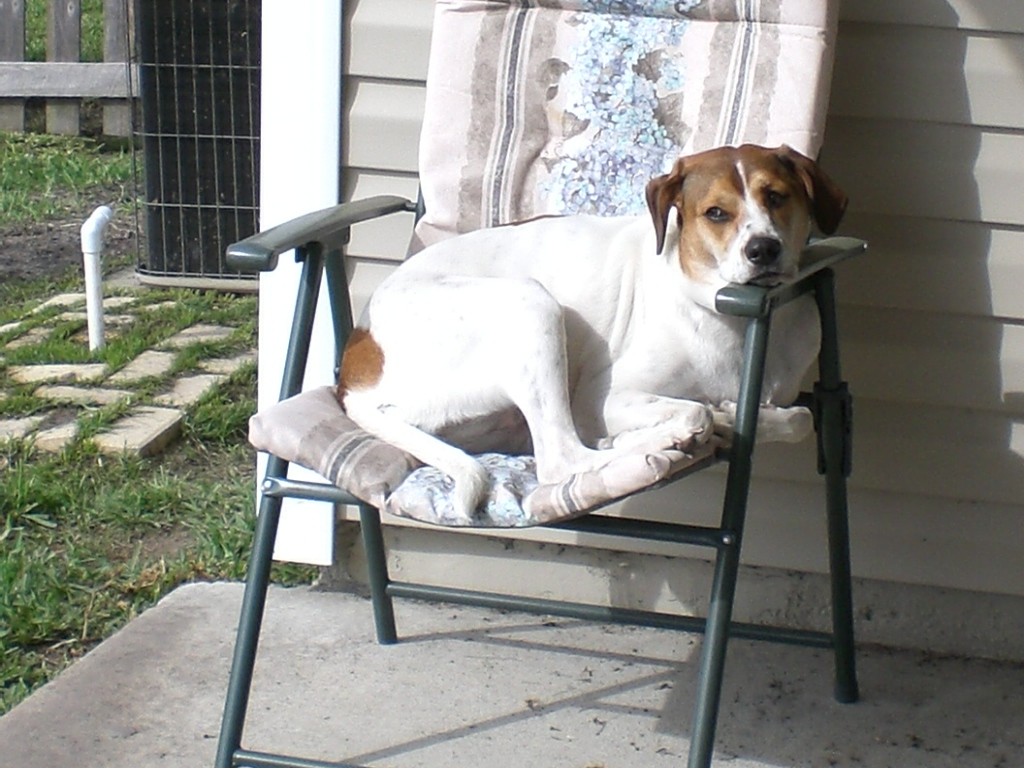
Dalglish, a beagle/spitz mix, was approximately 8 weeks old when my wife, Val, and I were led to him. And for fourteen years he made us laugh, he made us complete, he made us a family. Dalglish was a joker, a dog that when he was about 3 months old jumped from an eight-foot deck onto a six-foot fence and then down to the street to chase a squirrel, and then on catching up to it grinned at us and let it scamper away.  Dalglish was a peace-maker who hated when Val and I argued and would manipulate everything around him, including nudging our hands towards each other until we were holding hands, laughing, and talking again. Dalglish was a dog who would warn us of anyone coming to the door, barking incessantly until we checked it out . . . unless it was the pizza delivery man, any pizza delivery man, in which case he would sit silently at the door, smiling stupidly—a good trick because he was anything but stupid!  Here was a dog that loved everything about life.

But he had been failing for a while. The signs were there. We thought we had lost him in 2003 when he sustained a serious back injury, an injury that the vet informed us beagles were susceptible to, and he lost the use of his back legs.  There was one chance, just one, and if that didn’t work we may have to put him to sleep.  But this was Dalglish!  The high dose steroids worked slowly and his iron will pulled him back to health and back to his jovial self.  So even though he had now been failing this just another thing that we were certain Dalglish would bounce back from.

Which brings us back to March 11, 2005.  For a few days Dalglish had been lethargic, not wanting to move, not wanting to eat, not wanting to do anything. On the morning of March 11, he appeared to be having trouble with his back legs again, and this is why I found myself racing down I-95, not watching and not caring about the speed limit, and admittedly spending more time using the rear view mirror to look at Dalglish lying quietly in the back seat than looking at where I was going.  This was a race, a race to the vet’s clinic, a race that a small insistent voice inside my head kept telling me I was losing.

The car had hardly come to a complete stop in the vet clinic’s car park when I was out and snatching Dalglish from the back seat, heading for the clinic’s door. As I struggled to hold him in one arm and pull the door open with the other, I felt him slump.  It was as though what little strength he had left chose that time to desert him.  He was still breathing but this was not Dalglish, the clown, Dalglish the athlete, Dalglish the dog who would go through a brick wall to get at something that he wanted, in my arms. This was now my baby, my reason for living, that was dying in my arms.
I will never forget the vet assistants rushing out to grab Dalglish from my arms, to sprint with him back into the heart of the clinic.  Every breath of his was an effort.  As a nurse I have witnessed the rapid shallow breathing of the dying, the Cheyne-Stokes pattern of slow deep breaths gradually accelerating to rapid shallow breaths and then the sudden stop when everyone else in the room will subconsciously hold their own breath until the slow deep breaths resume and the pattern repeats itself.  But as a person every inch of my soul was screaming at me that I was not seeing what my eyes were taking in.  I saw the shaking of heads, I saw the tears in eyes, and I heard from somewhere in the distance a voice telling me that if Val wanted to say goodbye she had to get here . . .now!
There was a quick phone call to Val—I’m still not sure what I said—and I sat in the room with Dalglish, my hand on his head, while we waited a million years for Val to get there, but she didn’t make it in time.  The breathing pattern reached that rapid shallow crescendo, and then the pause . . .and I knew that the pattern was never to be repeated, that the pause in the breathing was to be eternal. It was over.

The dream started a few days later. As I say, it is a simple dream.  I am sitting in the car in the car park of a railway station.  The rain streams down the windshield.  And all I can hear is the song, I Can’t Stop Loving You, not the Phil Collins version but the earlier version by Leo Sayer. “So you’re leaving in the morning on the earlytrain.”  I slowly get out of the car and head for the platform and there is Dalglish, a small suitcase by his side, and a train on the rails obviously preparing to leave.  It cannot be anything other than a dream because of the small incongruities that such things often have: the train station is in my hometown of Dumfries, Scotland, a country that Dalglish was never in; the car I was driving was also the car I owned in Scotland, not the U.S.; the dog sitting on the platform is not the older Dalglish, rather it is Dalglish at about 5 or 6 years old.  The scene could be lovers breaking up, but it could just as easily be a beloved son heading off to college or to a new job.  In my head I am screaming for him to stay but the words don’t come out because I know this is something in which he has no choice . . . he has to leave.  He is smiling and his head is tilted to the left as if to say everything will be fine. But I know it won’t be.


The dream doesn’t come every night, sometimes it doesn’t even come every week, but I know that it will keep coming.  And I don’t know if I want it to stop because just seeing him again brings a smile to my face and lifts my heart, but it also reminds me that we will never physically be together again.  I will never again feel him snuggling in behind my knees as I lie in bed. I will never again trip over as I try to rise from a chair because he is parked at my feet.  But somehow, as I see him smile, I know that he was right . . . everything will be okay, and my life is so much better because he stayed for a while.

Sunday, April 14, 2013

Animal Rescue and Heavy Metal Music: Strange or Perfect Bedfellows?

Sometimes events collide that kick the strange workings of my brain into overdrive. Connections that I would never previously see suddenly start lining up.  This happened recently when a local “metal” band, All ThingsDone, in Jacksonville, Fl. offered to hold a benefit concert for Pet RescueNorth.  As a music fan with extremely eclectic tastes—my music collection literally ranges from Beethoven to Black Sabbath—I was over the moon about this event. However, the more I thought about this collaboration between an animal rescue organization and a metal band with all the negative stereotypes that they carry—stereotypes of preoccupations with death and suicide, images of animal cruelty associated with Satan worship and memories of Ozzy Osbourne biting the heads off live animals—the more I realized how some would question this partnership. And the more I thought of how people would question the partnership, the more I came to one conclusion: Heavy Metal Music and Animal Rescue could not be a more natural fit!

Metal music is, arguably, the most misunderstood  and, in some quarters, reviled form of music on the planet. Sociological theories on the attractions of such music and the subconscious needs and motivations of its fans are everywhere.  And, for various reasons, many of the theories remain rooted in stereotypes.  This discussion, for reasons of space, will itself address stereotypes and remain relatively simplistic. I have neither the time nor the inclination to write any sort of academic thesis here. However, one fact must remain at the front of our minds: what attracts people to any specific form of music, including metal, and the individual personality-types is way too complex to allow for everyone to be lumped into one pigeon-hole!


So, why do I think this partnership is a natural fit? Let’s start with one of the predominant theories about why people are attracted to metal music.  It has been widely touted that metal music attracts those with a sense of alienation, of isolation. A need for those who don’t quite fit in with the rest of society is being met by metal’s themes of fear and despair, themes that reflect the dark side of humanity.  Musical expressions of violence and anarchy reflect a feeling of hopelessness, a feeling that the world around the individual is spinning out of their control and that a refusal to comply with social norms constitutes a refusal to participate in the social behaviors that are working to subdue and submerse those who are a little different.

The musical expression of such beliefs does not mean that the fans will physically act out on those ideas.  It can be regarded as a “what if”, no different to the basis of every novel ever written, but how many people act out the contents of a novel? So why are metal fans regarded as any different in that respect?

Okay, so we have a bunch of people who feel isolated and alienated in some way and are looking for some way to fit in. How do you fit in?  Simple . . . you look for those with the same feelings of isolation and alienation.  You look for those that you regard as your peer group!  And who are more alienated and isolated than animals who rely on humans for their care, yet who have been abused, neglected, and abandoned to fend for themselves or to die trying.

In the animal welfare world breed-specific-legislation, the banning and indiscriminate killing of a specific group, for example, is an extreme form of control over those that are seen as somehow different and dangerous.  Is it any surprise, therefore, that metal fans feel a need to align themselves with those breeds of animal?  It can be argued that to take up the fight against BSL, or to rescue any abandoned animals, is to act in defense of kindred spirits.

Similarly, the stereotype of Satan-worship, the use of satanic themes and symbolism in the music is merely an artistic tool.  While some may actually become interested in satanic rites, it does not reflect the actual beliefs or values of the majority of metal fans.  In fact, from my personal experience, it may surprise many people just how many of those sitting around you in your Christian church on a Sunday are then going home and turning on their Black Sabbath or Judas Priest or Pantera CDs.  The music is often a reflection of how the metal fan views the world around them rather than how they view themselves.  The music frequently is not describing the metal fan, it is describing you, the non-metal fan, the moral majority, the bureaucracy and government, and the effects that you are having on the world.

Again, in my experience, if metal fans are attracted to non-conventional religions they tend to be attracted to belief systems such as Wicca, a nature-based belief system, or the theologies of Native Americans or other aboriginal groups—again, nature–based belief systems that emphasize a concern for the natural environment and animals that surround us. So, where is the surprise that animal rescue becomes a physical expression of those belief systems?

And what of Ozzy biting the heads off bats and pigeons?  Well, that is like asking if you want your peer group to be judged by the actions of one or two people. Look at any sociological grouping of people and you will find the mentally ill, or the somehow deviant, acting in ways that the majority of the group will find incomprehensible and that are often contradictory to the beliefs of the rest of the group.  An individual, possibly mentally ill but definitely drug-driven, compounded by a showbiz persona created to maximize shock value does something that he knows will sicken the masses: not exactly representative of most sociological groups, including most metal fans.

So, on June 22nd 2013, a metal concert starring All Things Done and Nocturnal State of Mind, along with guest stars will be held at the Landshark CafĂ©, Jacksonville Beach, Fl.  Some people might still think “how strange?” but I for one am stoked about this event.  If you don’t like metal music you don’t have to go—I would never ask a non-metal fan to subject themselves to that—because there are so many other ways in which you can support Pet Rescue North.  But please don’t knock it; it will be great to see all those “metalheads” who are also animal lovers together in one place!


As previously mentioned, this is not meant to be an exhaustive examination of all things metal, just an overview of why metal fans seeking to help rescue animals is the most natural thing in the world. It is also not meant to be an indictment of those who are not metal fans.  Just file it under “never judge a book by its cover”. The next time you in your smart business suit are standing next to someone in black leather and studs or ripped jeans and long hair, just remember: they may have more in common with you that you think!

I Guess I've Been Away for a While

Yep, I'm back.  It has been a while and I have no excuses . . . reasons, but not excuses.  There is another writing project that I'm supposed to be working on and, in some ways, the content conflicts with the content that would be necessary here.  And, of course, this conflict has led to a massive case of writer's block. Of course, I am not writing off the possibility that I am simply a lazy bugger.

Anyway, thanks for staying with me throughout the extremely sporadic posting of content.  Look for more in the near future.  But let's start off with this next piece . . .

Sunday, February 3, 2013

Caring is Caring!

“If having a soul means being able to feel love and loyalty and gratitude, then animals are better off than a lot of humans.” ― James Herriot

It is often asserted that those who love animals must, almost by definition, be regarded as kind and compassionate humans. Many recent comments by supposed animal lovers  on popular social media, however, have exhibited  an inability to empathize with, and even an attitude of cruelty toward, their fellow humans when those people are most in need of kindness and compassion. So, does love of animals translate into an ability to empathize and show compassion?

Let’s compare behaviors in two situations: one where it can be argued that, despite the animal-related content, the respondents are not necessarily animal lovers and one where the animal–advocacy leanings of the respondents cannot be denied!

After a recent Facebook post by MSNBC’s The Ed Show announcing the death of former President George W. Bush’s Scottish Terrier, Barney, and the offering of their condolences, one responder posted that perhaps Barney committed suicide because of who his owner was.  Another “joked” that perhaps Barney died because the President dropped him on his head.  I admit that I never agreed with anything President G. W Bush said or did, but I have suffered the loss of a beloved pet (more than once) and know how devastating this is. In his time of grief the truly compassionate would, and some did, set aside their political differences to empathize and offer emotional support.

Unfortunately, it is true in our politically polarized country open expressions of cruelty from the uninformed, the self-absorbed, and the irretrievably biased are expected. In this case expectations were obviously lived down to!

However, it never fails to amaze me, as in the following example, the degree of cruelty that can be expressed by a section of the population that is supposed to be, and frequently claims to be, compassionate: Animal advocates!


The Flyer I Created To Publicize Humphrey's Plight.
In a recent post on Facebook attempting to re-home a blind St. Bernard/ Boxer mix called Humphrey following the traumatic brain injury of one of the owners in a motorcycle accident, there were the usual helpful suggestions and expressions of concern for a dog that was being displaced from its family of several years.  But intermingled with these were attacks on the family who suffered the tragedy.  How dare these people just dump their dog because a family member was now brain-injured! Examples of these are:

·         “Families members only think of themselves don't give a shit about there other family member there pets people are disgusting. Love a pet and leave him worst part is he's blind and mostly horrified people really do six is there laws for these people wtf” [sic]

·         “How could they do this to there poor boy so bloody cruel,I hope and pray some good person takes him in bless him,so bloody heartbreaking and he will be feeling that hurt too poor love” [sic]

·         “[T]his pup should be a comfort to the family instead of a throw away . . .”

Faux intellectuals even tried to disassemble the wording on the flyer created to publicize Humphrey’s plight looking for evidence which would allow them to trash the family.  It should be remembered when reading the response below that the information available to rescue organizations for the creation of such flyers is limited and often, people such as myself (yes, I created the flyer)  simply try to highlight the urgency of the situation: we do not have the entire life story of the family available to us!

·         “How do you throw out an EIGHT year old dog after having him since he was a puppy? Another odd thing about this post.....and I quote, "The HUSBAND of his owner was tragically and devastatingly injured ......" So its NOT his owner that was injured BUT THE HUSBAND of the owner! This is terrible that the OWNER WHO WAS NOT INURED is getting rid of this helpless dog. WHY doesn't someone do a fundraiser for the dogs upkeep so the dog can remain in the home? Why is the OWNER who was NOT injured doing this?” [sic]

In Humphrey’s case, such responders are apparently incapable of placing themselves in the family’s shoes.  Traumatic brain injury to a family members places extraordinary pressures on a family.  Medical care, rehabilitation, potential personality changes on the part of the victim, specialized equipment, loss of income, and many other problems are potentially in this family’s future, especially in a country that is not renowned for how well it provides for victims of trauma, and yet they make approaches to animal rescue organizations in an attempt to ensure that their dog, who is himself in need of special care, receives the care that they feel he deserves and that they no longer can provide.  And what is the result . . . someone says they “don’t give a shit”, another that they are “so bloody cruel”. Anyone notice any similarities between the behavior in the two examples?

In his book on ethics, On The Basis of Morality, German philosopher Arthur Schopenhauer wrote, “Compassion for animals is intimately associated with goodness of character, and it may be confidently asserted that he who is cruel to animals cannot be a good man.”  Unfortunately, taken out of its place in a much larger work as it often is this statement on its own commonly leads to a logical fallacy. The proximity of the two elements of the statement leads people to accept the statement as meaning that if being cruel to animals equals not being a “good man” then compassion for animals equals being a “good man”.  This is clearly not true!  Surely goodness of character involves being compassionate to more than one group!  Compassion for animals is certainly an indicator of the ability to empathize, to be compassionate, but it does not guarantee that the ability will be used in all cases.

I am the first to howl at the moon when I see blatant examples of dog-dumping.  We have all seen the tell-tale excuses (and I have written about them frequently): someone has allergies, there is a new baby coming, we can’t give them the time (even when there have been no life changes), etc.  In the presence of extensive information available on how to overcome such problems, these excuses indicate a lack of effort, an unwillingness to try.  But something like the traumatic brain injury of a family member is a truly life-altering event, an event that changes everything, an event that means your life as you knew it before the event is gone and those resources and circumstances that were yours before the event may never return! And possibly, just possibly, the most traumatic part of this life-altering event is that you now know, in all good conscience, that you cannot look after your pet in the way that they deserve!

So come on animal advocates, caring for animals does not mean losing our ability to care for people when the circumstances warrant!  After all, the companion animals we claim to represent are able to show compassion and love unconditionally!


Sunday, January 27, 2013

Update on How to Donate for Sharla's Medical Care!

Okay, some confusion seems to have developed over who is going to provide the medical care for Sharla, how the bills will be paid, how donations are going to be collected, etc.

This is nobody's fault . . . when several parties are involved in rescuing a dog and there is an urgent need to raise awareness and funds communication breakdowns sometimes happen! 

So from this point forward the information below should be regarded as the definitive information regarding donations, etc.

Pet Rescue North will continue to provide updates, and will support efforts to bring this beautiful dog back to full health, but in the interests of simplicity and avoiding further confusion they will take a step back and allow Sharla's new foster family to take the lead in this case. This will avoid the counter-productivity of competing fund-raising efforts and, now that Sharla is in foster care, allow those who are dealing directly with Sharla on a daily basis, i.e. the foster family, to base the care decisions on what they are seeing first-hand. 
 
 
News regarding Sharla's progress can be found at www.facebook.com/sharlasnewstart
 
Once again, thank you to everyone for caring. It must say something abut how special Sharla is that so many people were trying to help right from the word go!


How to Donate to Sharla's Care

For those of you who read yesterday's post about Sharla and her need for intensive and expensive medical care I have a couple of updates:

Donations can be made via PAYPAL by visiting Pet Rescue North's Website and clicking on the PAYPAL button.

Alternatively, checks and money orders made out to Pet Rescue North, Inc. can be mailed to Pet Rescue North, Inc. P.O. Box 28574, Jacksonville, FL 32226-8574

Please indicate in some way if the donation is to be used specifically for Sharla’s care. If PAYPAL does not offer this opportunity, simply drop an email to PRNorth@Yahoo.com informing them that you have made a donation and this is the purpose it is to be used for!


Also, as I entered in a comment yesterday, Sharla has a FB page now and you can follow her progress in her new foster home. Alternative methods of donating to her care can also be found there.


Sharla's First Meal in her New Foster Home!
Sharla desperately needs your help!  Thank You for caring!

Saturday, January 26, 2013

Please Help Sharla!

I’d thought of various ideas for this week’s post, some amusing and light-hearted, some less so, but then, through my volunteering with Pet Rescue North, I learned of the plight of Sharla . . . and this is so important it must take precedence over all my other thoughts!

Warning: Some of the photos are graphic and disturbing and were taken during various veterinary assessments.

 
Sharla was essentially left outside in the dirt for years with minimal, if any, care at all.  She shows all the signs of neglect: fleas, malnourishment, loss of energy etc., but, worst of all, she has a massive tumor on her left hip.  Whether this tumor is malignant or not still has to be determined but Sharla is in such poor shape that surgery cannot even be attempted until her general health improves dramatically.


Now the tumor is growing rapidly and is affecting her ability to stand and walk properly.

And still, Sharla shows her trust in humans . . . part of the vet assessment describes her this way: “Patient is very gentle, friendly, BAR, and mentally appropriate, soliciting human interaction. Wags tail with attention or when spoken to, approaches when called. Somewhat unsteady on feet, but significant emaciation and poor body score (2/6,) and weight shift heavier on left hip due to large heavy mass pulling to left side. Obvious weight loss and somewhat sagging skin as secondary effect. General appearance suggestive of dog >12 years, generally debilitated, negative energy balance.”

Now is not the time to go on a rant about the kind of “people” who can allow this to happen to an animal in their care (and I have lots of thoughts regarding that); Now is the time to think of Sharla and what can be done to save her!


Sharla has been rescued and is in a safe and caring environment at the moment.  However, the cost of the medical care necessary to get her into shape for treatment of the tumor, let alone the costs of that treatment when it occurs, will be enormous. Pet Rescue North is sponsoring Sharla’s care, but as a small organization they do not have the funds available to go it alone.  So they are asking for help from the animal-loving public! 

In the several years that I have been helping Pet Rescue North in what little way I can, I have never known them to directly ask for donations from the public for the care of a specific animal . . . to me this is an indication of how serious Sharla’s condition is.

If you would like to help in some way, you can contact Pet Rescue North by emailing PRNorth@Yahoo.com.
 
Hopefully, there will be more specific details on how to donate forthcoming in the very near future and I will keep you updated. Until then, you can follow what information there is on Sharla’s progress by visiting and “liking” PRN’s Facebook page!

Sunday, January 20, 2013

JUST WHAT HAPPENED TO THE AFLAC DUCK?

For my first post since the winter hiatus I am going slightly off topic in that I am not directly mentioning companion animals.  Instead, I want to know . . . just what happened to the AFLAC Duck?


Were these injuries the result of some over-zealous, but incompetent PETA representative attempting to enforce a belief that death is preferable to exploitation? And, if so, did they ask the duck if it chose to represent this company or was it forced?

Was the duck a victim of someone, say a farmer, who believes that animals should know their place, and television stardom is not their place?
 
Perhaps the injuries are the result of an escape from a care and protective services “shelter” that had deemed the duck unadoptable?  After all the duck has in previous appearances shown itself to be rather strong-headed, independent, and even aggressive in getting its point across!

Could the injuries be self-inflicted; a result of the stress inflicted by being a public personality?  After all, everyone has read of stardom leading to what seem to be psychotic breaks or self-destructive behavior! Was the constant pressure to perform the breaking point or, possibly, did the realization that he was a phenomenon, a special individual, living a life of luxury while his fellow non-humans were being slaughtered for the crime of being homeless just too much to stand!

Undoubtedly, we will learn the truth in the near future.  But will this revelation be just another stunt by an enthusiastic but uncaring PR advisor? Let’s hope we get to hear the real story from the true victim . . . the duck!

Monday, December 17, 2012

Temporary Hiatus

Apologies to anyone who has been looking for new posts recently. The paying job has been kicking my butt recently, and I will be traveling over the holiday period.

But keep your eyes peeled in the New Year.  I will be back with more for all you dog lovers out there.

Thanks for keeping the faith!

Happy Holidays to every one of you!!!!!!

IanF

Wednesday, November 21, 2012

GIVING THANKS –DOGGY STYLE!

Okay, so it’s Thanksgiving.  A time for giving thanks for everything that enriches our lives. A time for acknowledging how blessed we really are.  So, I thought I’d list a few of the dog-related things that I am truly grateful for.

I’m thankful for every dog, past and present, that has been a member of my family.  From my youngest days to my current state of rapidly advancing years (okay, I’m not that old, but some days it feels like it!), I have constantly been amazed at the unselfishness of these amazing animals.  Some of those dogs were with us for only a short time—as a child I learned the dangers of buying from a pet store when it was discovered our gorgeous puppy, Tuppence had contracted distemper—others were with us for their entire lives, and others are still with us.  Each and every one brought joy and laughter. They played the peacemaker when necessary and played the clown when it was most needed. Every single dog displayed a distinct personality, and every one brought something new to the family!  There is more than a hint of truth when you hear animal owners proclaim that they did not rescue the animal, the animal rescued them!

Not only am I thankful for the canine members of my family, I’m thankful for every dog and cat that I have met during my brief time in the world of animal advocacy and rescue.  Their unconditional love and their hopefulness in the face of often devastating adversity is a constant inspiration.

I’m thankful for the selfless devotion of the animal rescue advocates that it has been my pleasure to become acquainted with.  Time and again, I discover that although I think I am active in animal rescue and advocacy, my contributions are miniscule and insignificant compared to those of others. Also, if it was not for these people, I would never have received the companionship of my 3 current dogs: Suzie, Shadow and Sam!  I am especially thankful for the volunteers at Pet Rescue North, a no kill shelter in Jacksonville, Fl that you have heard me mention many times before, for Peggy and Mary Ann, for Fred and Deb, and for the many others that I have never met personally.

I’m thankful for the work of advocates such as Nathan Winograd, The No Kill Advocacy Center, and The No Kill Nation who work tirelessly to expose the hypocrisy of organizations killing healthy and treatable animal that they are supposed to be caring for, and to debunk the bureaucratic excuses used to rationalize this behavior.  It is the work of people such as Nathan (hopefully, I’ll get to meet him one day) and the related no kill organizations that bolster my belief that one day the United States will actually become the nation of animal lovers that it is supposed to be.

I’m thankful for my loving wife, Val, who not only agrees with and participates in my animal related activities—few as they may be—she puts up with every time these activities interrupt something else: my time at the computer advertising dogs in need, my black moods when the stories of despair seem just too much, and the days when it must seem as though the dogs are more important than she is.  Don’t worry; I’m pretty sure she thinks the dogs are more important than I am!

Obviously, the list is incredibly incomplete and, in some ways, I am thankful for that also. If I could include everything animal-related that I am thankful for in a short list, it would mean that only a few animal-related things in this world were worth giving thanks for . . . and this is so obviously not the case!  We have been tasked with the responsibility of protecting this amazing planet we live on, and with caring for the vast array of life upon that planet, and thankfully it appears that an increasing number of people are taking that responsibility seriously!

Take a moment to give thanks to your companion animals. They are doing what comes naturally to them but, even if you don’t realize it yet, they are giving you a gift just by being in your life . . . and I’m sure your parents taught you that you are supposed to be thankful for gifts!

So from Val, Shadow, Suzie, Sam, and me to all friends of animals out there, and their companion animals:


WE WISH YOU ALL A WONDERFUL THANKSGIVING!


Sunday, November 18, 2012

DYING FOR THE HOLIDAYS!

Some recent animal-related events in the North East Florida region have kept me from posting on this blog as frequently as I would like.  I am sure my readers accept that trying to save animals must take precedence. However, one of those events is worth discussing here.  In the callous world of so-called animal “shelters” killing healthy or treatable animals rather than truly trying to find homes, this struck me as particularly horrendous.

101512-11JP 003Bradford Co. Animal Shelter and Control, Starke, Fl 
On Sunday, 11 November, 2012, an email was circulated around various animal rescue organizations and advocates in N.E. Florida. The subject was the Bradford County Animal Shelter and Control located in Starke, Florida and the email contained photographs and a list of over thirty cats and dogs at the shelter.  Animal advocates in this area are well aware of this “shelter” and its killing policies.  In my limited experience I have not dealt with this particular “shelter”, but one advocate, a person I trust implicitly, stated that, “This shelter is so poor that they euthanize in each kennel then lay the dogs in the aisles where the other dogs can smell and see.”

As expected, recipients of the email sprang into action—spreading the word through social networking—to see if these animals could be saved.  After a few days, one person that I know of contacted the “shelter” to ask how long we had to find homes for these animals.  And it was in the response to this question that I discovered one of the most callous, heinous, and unforgiveable attitudes that I personally have heard of: They hope to have all the dogs gone one way or the other by next Wednesday due to the [Thanksgiving] holiday.


102512-QA 003 Bradford Co. Animal Shelter and Control, Starke, Fl 
Because I am a third party to this communication this is as close to a direct quote that I can be and I added the emphasis, but when I asked the recipient of this statement whether I was interpreting the statement correctly, that the animals will either be rehomed or will be dead by next Wednesday, it was confirmed that I was not the only one interpreting it that way!  And to prove the accuracy of this statement we then heard that the killing would begin on Monday, 19 November, 2012!

People in the animal rescue world are used to such deadlines, but what I find most horrific is the underlying text of the statement: If the facility is empty on the Thanksgiving holiday, the staff will not have to interrupt their own celebrations with the need to go into work to look after all those pesky critters!

Think of the meaning of Thanksgiving, a holiday where Americans traditionally give thanks for all that is great in their lives, a holiday that celebrates the blessings we encounter each and every day, a holiday where many give back to those less fortunate than themselves.  Apparently in Starke, Fl (and in many other communities around this country) this giving back doesn’t extend to our four-legged friends, many of whom were previously in homes until they became a nuisance for some reason.  Perhaps they became old or ill or just too damn inconvenient!  Whatever the reason, I wonder if those former owners knew that their former friend and family member would never see another Thanksgiving?


101512-13JP 003 Bradford Co. Animal Shelter and Control, Starke, Fl 

It should go without saying that Bradford County Animal Shelter and Control (interesting how the word “control” is slipped in at the end of the title there) is not the only organization clearing the book so they can enjoy their holiday; they just happened to come to my attention.  So will the staff of those shelters be giving thanks for their day off? Will they be down on their knees asking forgiveness for what they had to do in order to get that day off?  Or will they be too busy stuffing their faces to worry about it?

The America that I chose to become a citizen of is supposed to be a nation of animal lovers. How can this be true when some people are able to celebrate because of the indiscriminate killing of innocent animals? And I hope I don’t hear any of the usual bureaucratic excuses . . . I don’t see the hospitals killing off their patients so the nurses and doctors don’t have to go into work on Thursday!


Sunday, November 11, 2012

Who says the public doesn't care!

In the works of Nathan Winograd a recurring theme is the excuse given by kill-shelters that there are not enough people who care, not enough people willing to adopt, not enough people willing to foster, and therefore animals must be killed. Nathan Winograd argues against this vehemently. I just thought today I would share an experience that supports Winograd rather than the excuse makers. 

flyer posted on PRN's Facebook page
 
Recently, a speckled coonhound was surrendered to a vet’s office by the owner who claimed a history of food aggression and snapping or biting from this dog. An employee at the vet's office who received the dog sent out an e-mail stating that they had seen no evidence of this, but, unfortunately, they would be unable to keep the dog more than a few days. If they were unable to find the dog a home by Sunday, 11 November 2012 the dog would have to be euthanized as requested by the owner. Pet Rescue North, a local no kill shelter in Jacksonville Florida, unable to save the dog directly because their kennels were full, posted this information on their Facebook page seeking help.  

Pet Rescue North is a small organization with only just over 400 likes on Facebook, but the response was overwhelming. The post resulted in over 700 shares and almost 200 comments. Ultimately, the result was that a forever home was found for this dog. It is worth noting that comments were posted from as far away as South Africa. The forever home that was found was in Daytona, Florida, almost 100 miles away. Now the only problem is arranging transportation. This is a minor problem, but the most important thing is that this dog has been saved. 

The question has to be how can anybody claim that the public is not supportive of no-kill policies when a tiny pet rescue organization can put a simple request on Facebook and more than twice the number of people that they should reach shares the request in such a positive manner? 

The mission of no kill shelters is to save animals, whether those animals are in the care of that shelter or not. However, their efforts are being hindered by this belief of the kill shelters that the public does not care. When one small shelter can reach so many who care what could happen if kill shelters adopted policies of communicating with the public rather than just bureaucratically killing animals because they believe no one will care! All they need to do is give us time. 

Just as a final thought, this experience showed some of the limitations of Facebook, and will no doubt provide the basis for many posts on this blog to come. However, as far as the concern that the public may not care about the unnecessary killing of animals goes this experience blows that argument out of the water! So if you live in an area where the pound or the local shelter claims that there are not enough adopters out there, tell them that they are not working hard enough!

Sunday, October 28, 2012

Kill Shelters: Animals May Not Be the Only Victims!


The failure of any local animal shelter run by a city or county government to effectively embrace and implement no-kill policies and procedures detrimentally affects all the no kill organizations in that region, and places untenable demands on the resources of those organizations.  This effectively limits the ability of the no kill organizations to achieve their adoption goals.  As a brief example, recent events in Jacksonville, Florida, will be described followed by my interpretation of the problems that exist.   

Please note that this is not an attempt to vilify Jacksonville Animal Care and Protective Services (ACPS) in particular.  Rather, it is simply a case of local familiarity on my part.  ACPS has done more than many governmentally-run shelters in reducing its kill rate (and less than some others) but recent events mirror what is happening in cities and counties throughout the country. 

Last week, ACPS once again issued an urgent plea for help from local animal adopters, foster families, and rescue organizations.  With the shelter full and actually over capacity, the plea contained a sympathetically and carefully worded but unmistakable threat to the lives of the animals. Inevitably, in the ensuing scramble to rescue the animals that ACPS now has to kill, the needs of the local no kill organizations become secondary to the needs of ACPS.  Available space is used to pull animals scheduled to be killed at ACPS, space that may have been used to house animals from other sources. Foster resources slated for use by the animals that come through the doors of the no kill shelters are now used to save the animals from one source, ACPS.  Advertising resources such as social media focus on seeking homes for the animals in ACPS rather than seeking homes for the animals already housed in the no kill shelters.  

Frequently, because ACPS is one of the best known shelters in the area and therefore a larger beneficiary of donations, volunteers, etc. (in addition to its admittedly meager government funding) than many others, the organizations being asked to help are smaller, have fewer advertising or public relations outlets, are less financially stable than ACPS, and are already stretched to breaking point, but because of their mission they feel compelled to help.  Not to do so would be hypocritical. Therein sits one problem: In an environment where, ideally, all organizations would be cooperating to achieve maximum benefit for all, the benefits of all but one organization are subsumed.   

Undoubtedly, ACPS has made huge strides in its live release versus kill rate over the last few years.  The work of organizations such as Friends of Jacksonville Animals in fundraising and notifying the public of animals available for adoption through ACPS has played an important part in this.  ACPS and its various partner organizations have made much of their desire to become a no kill facility and the publicity campaign has been so successful that some members of the local community seem to believe that ACPS has achieved no-kill status.  Nothing could be further from the truth but this misconception causes another of the underlying problems.  If the public believes ACPS is no kill then no sense of urgency to act exists until the latest news broadcast informs them of how many animals are about to be killed.  

As has been noted, the public awareness of ACPS, the public profile, means that they receive a large portion of the local charitable “pie”.  Yet their very existence and their kill policies, while reducing the resources available to other organizations, demands that their needs be met even when helping could push the smaller organizations over the edge in terms of financial viability.  It is not unlike allowing the demise of many smaller banks in order to save the big financial institutions during the recent economic crash. 

Additionally, the public profile of ACPS aided by its position as a governmental organization provides easier access to and coverage by local news organizations.  This makes the misconceptions about ACPS and the cyclical urgency to empty the shelter en masse (leading to the stress on other organizations) rather than achieving a steady flow of adoptions to counter the number of intakes all the more mystifying. Arguably, there is no animal rescue organization in Jacksonville that is more widely covered and reported on by the local news media:  regular television spots, blogs on the website of the local newspaper, etc.  This is media access that other shelters or rescue organizations only dream of and if used correctly should minimize the frequency of these “emergencies”. 

There can also be no doubt regarding the support available from the local community when they are given easy access to adoption services. For example, over the last weekend of March 2012, three organizations—including ACPS-- combined in what was known as the “Mega Match-a-Thon”. The goal was to find homes for 250 dogs and cats; the result was 304 animals found homes.  Approximately three and a half months later, during a multi-organization event, again including ACPS,  held at the Jacksonville Fairgrounds a goal of 800 adoptions was smashed when over 900 cats and dogs found new homes. 

Having said all this, it is obvious to anyone familiar with the No Kill Equation as proposed by the No Kill Advocacy Center that all the pieces are in place for ACPS to move fully toward its stated No Kill goals: a high public profile, proven public support, easy media access to increase donations and volunteers, a solid network of partner organizations, etc. The missing element appears to be the element that the No Kill Advocacy Center identifies as one of the most vital: Leadership committed to a No Kill future! This lack of leadership may be within the department itself, or it may be at the level of city government, it is not for me to say where, but there is no doubt of its existence.  A few months ago ACPS experienced budget cuts as part of a citywide budget restructuring.  The most widely publicized result was the demotion of the adoptions and rescue coordinator, June Mason, and her replacement by someone who had been involved in animal rescue related positions for less time than June but had been a governmental employee longer. During her employment in the position, June developed positive relationships with rescue organizations throughout not only the state but also the country.  A huge public outcry including a petition containing well over a thousand signatures failed to overturn a decision that was based on established union and governmental policies rather than on the welfare of the animals.  It is such blind adherence to bureaucracy rather than to proven effectiveness that prevents shelters throughout the nation from moving toward no kill status.  Perhaps no single event demonstrated the negative impact of June’s demotion more than the fact that this most recent plea for help was issued by ACPS’s Division Chief because the adoption and rescue coordinator was “not available”, an occurrence that I never witnessed when June held the position! 

I must reiterate that this is not an indictment of ACPS.  It is a reflection of something that happens on a daily basis in the United States because of the failure of the local “pounds”, for whatever reasons, to do the right thing, to embrace the no kill philosophy, and to use the advantages of their governmental position to bring this into reality. If all locally run shelters became no kill they could then become full members of the animal welfare community with all organizations pooling resources to work toward a common goal. A full partnership would result in the frequent saving of two animals for every one adopted: If the no kills could focus on adopting out their own animals, then every adopted animal creates a space to pull another from a kill shelter. A constant flow of adoptions and rescues could relieve the pressure on the kill shelter and the no kills. Until that occurs, government shelters will continue acting as an entity that all other organizations are expected to compete with, but are still expected to pull from the fire on a regular basis. And when, as they always will, the no kill organizations use their valuable resources to come to the aid of the kill shelters it is worth asking, not only about individual animals but also about smaller rescue groups: How many will not survive this time? 

Friday, October 19, 2012

"Accident", “Bureaucracy Gone Mad”, or “WTF?” The Needless Killing of Healthy Animals!

Think Lucky would surviuve your local shelter? Fortunately, she is in a no-kill shelter!
I believe in a no-kill philosophy when it comes to shelter animals. I follow several animal related blogs, Facebook pages, etc. But I can hardly be accused of obsessively scouring the news each day for stories about shelters needlessly killing animals in their “care”. Yet here we are on only the 19th day of October 2012 and already this month two horrendous stories regarding this particular topic have caught my attention. Some describe the situation leading to this as bureaucracy gone mad but, to me, a more appropriate response would be an acronym that is popular in the modern vernacular: WTF?

The month began with the story of “Toothless”, a cat belonging to eight year old boy in Logan, Utah, being “accidentally” killed by a humane society shelter when the family had informed the shelter that the cat would be picked up the following day. 

Yesterday, through a Facebook post by the No-Kill AdvocacyCenter, I learned of a dog being “accidentally” killed by the Central California SPCA when the family had already informed the shelter that they would be there to pick up the 11-month old Pit Bull named Scar. Apparently, after getting out of the yard, Scar was taken to the shelter by a neighbor who made various accusations against the dog, none of which were substantiated during an investigation by the SPCA.

In my opinion, there are two issues here. One is the culture of these shelters where killing healthy animals is not only accepted but even expected and often encouraged. The rush to kill animals is, in its own right, abhorrent!


The second issue is the apparent lack of checks and balances to ensure that such “accidents” do not occur. It is not difficult to disseminate information throughout a shelter stating that a family is coming to pick up an animal or that a rescue, be it adoption or fostering, is imminent. As a nurse I have worked in many hospitals and know that, although mistakes happen, the policies and procedures in place to keep these mistakes to a minimum are numerous: two licensed nurses checking medication orders, the five “rights” of medication administration (right medication, right dose, right patient, right route, etc.), the physical marking of limbs to be operated on, etc. to name just a couple of examples. So why aren’t there similar policies and procedures in place where animals’ lives are at stake? Or, if there are, why is nothing being done about incompetent workers? A nurse found guilty of such incompetence would be fired and their license revoked in a heartbeat. 

Think I’m exaggerating the problem by just naming two incidents? According to the No-Kill Advocacy Center, “‘Accidental’ killings of beloved pets happen every day in shelters in this country. Google ‘shelter mistakenly euthanized pet’ and you’ll get ‘About 205,000 results (0.34 seconds).’” Try it. I did and got 226, 000 (0.40 seconds). Now, admittedly, some of these results may be reported in more than one place. Some may be reported in more places than in others but, to pick an arbitrary number, let’s say that each incident is reported in an average of ten places . . . that is still 22, 600 incidents. Before you object, I know that this is not a scientific assessment of the number of individual incidents, but I hope you get my drift.


While hospital-like checks and balances may help—they don’t solve the problem, but they may reduce these “mistakes”--the only true way to end these tragedies, to stop healthy animals dying needlessly, is for the pet-loving public to pressure their local shelters into adopting a no-kill philosophy. Find out how you can achieve this at the No-Kill Advocacy Center’s website. Some of the rescue groups in your area may already be no-kill, but it is likely that the local government-run facilities—even if run by a “humane society” or a “society for the protection of animals”—are not! 

Unfortunately, until this happens, it seems that I am destined to say frequently, “WTF?” followed closely by, “Not again!”


Saturday, October 13, 2012

SHOULD I FOSTER OR ADOPT?

My admiration for those who foster recued animals is enormous, but I frequently wonder how they can give up those animals in their care when a forever home is found.  My personal preference has always tended towards adoption rather than fostering, but that may be changing. What follows are my evolving thoughts on why true animal lovers should consider the possibility of fostering rather than adopting. Is it possible that fosters are performing a more valuable service to their animals than they would by adopting them?  

My wife, Val, and I have adopted several dogs over our lifetime.  But as, yet again, we see the signs of the impending loss of a beloved family member—the greying of the muzzle, the increasing number of days when sleeping seems more important than playing—a loss perhaps not imminent but undeniably inevitable, our thoughts increasingly turn to what we will do when our canine family is reduced by one. And with increasing frequency Val’s conversation veers toward fostering rather than adopting. 

I openly acknowledge that I possess a selfish streak. I adore the relationships that I build with my dogs over the years, and I dread the loss of each one of those relationships. The death of previous dogs left holes which never filled completely, even when a new dog entered the family.  Our only encounter with fostering seemed to reinforce my belief that I could never willingly give up a dog once they had entered our home. 


Lulu
This happened when a gorgeous young stray we named Lulu followed Val and Shadow home during their morning walk. We knew we could not care for another dog on a long-term basis and as we tried to locate Lulu’s owners, we thought that we had found a potential home with one of the techs at a local vet’s office.  This was not to be.  Through no fault of Lulu’s, the new owner found she was unable to keep Lulu and we had to take her back.   
 
It was then that we sought the help of our friends at PetRescue North (PRN) to find a forever home for Lulu. In the intervening weeks I quickly fell in love.  Lulu’s infectious smile and incessant playfulness not only brightened the lives of Val and me, but also of our other dogs. It was not long before a potential adopter was found, but I kept secretly hoping that something would render the application unsuitable.  There was no such problem, so we took Lulu to meet her potential new family.  Like us they were instantly smitten!  And, with mixed emotions, we left Lulu with her new family.  It turned out to be a perfect match: Lulu is loved and is given even more in the way of fun and care than possibly even we could provide.  Yet there is not a day goes by when I do not think of her. So how could I put myself through this on a regular basis?  

I discovered some possible answers to this question while planning the creation of materials aimed at increasing the number of foster available to PRN, materials which are still in the planning stage. As part of the process I posted a request on the PRN Facebook page for input from fosters regarding why they did what they did.  The response was immediate and passionate, and I have included some of those responses here.  I have had to edit some of the content because of space and repetition of ideas but note that in those edited portions several themes such as the number of dogs rescued by fostering rather than adopting appeared time and again! 
 
 
Catrina Harris said,  I always look at it like this . . . when you foster and let them go, you are giving them a chance at life, for a great home . . . letting go of one always means saving another life . . . if you keep them all, you are limited . . . .You may only be able to keep 5 dogs/cats in your home permanently . . . that is 5 dogs you have saved during the course of his/her life . . . which could be 15 years. Great, you saved 5 dogs in 15 years . . . but if you foster 5 dogs a year and find them homes . . . in 15 years you have saved 75 dogs. 

Sarah Speicher responded to my request by saying, Each time you let go, that's another happy family you helped create . . . It's not easy to let go, but that's when you get yourself another foster and pour all that loving onto them. 

Stephanie Hardee-Gant wrote . . . I love being a foster. The first time . . .  I won't lie. I cried like a baby when Rupper was adopted. But it always make me feel like I'm able to help and give love to so many more dogs this way. 

Catrina Harris again: There is no feeling like handing over your foster to their forever home . . . it is bitter sweet, but I keep in touch with a lot of my adopters years later . . . and they are some of my best friends now . . . I not only found these pets awesome homes, I gained friends all over the U.S. 

Cindi Depriest Van Vleck: I fostered to save lives because I know w/o foster homes none can be saved. Was it hard to let them go . . . yes some . . .  but each time the dog let me know that they knew the new family was theirs so it made letting them go easy .The pain of losing one foster was always replaced by the new face that needed a home for a while. 

Tanya Francisco Nelson: Another thing about fostering . . . it can work our great for people who travel a lot. This way you can have all the enjoyment of a pet when it is convenient for YOU without a full time commitment when it isn't. And you're saving lives. 

Alicia Merlino: A fostered dog may be more desirable because a potential family will know more about how the dog acts in that environment. 

Debra Williams: You may want to touch on the fact that by fostering dogs you give them a much higher chance of remaining in a forever home. Because they were fostered, they generally have been housetrained & learned some basic commands---which makes fostered dogs very appealing to those looking to adopt. Also, because a dog is living in a home versus a shelter--the foster family is able to get to know the dog & therefore pass on accurate information about how the dog behaves in a home setting. A foster family is more apt to know if the dog has any special behavioral needs. I think that the more info available to prospective adopters the better---kinda helps eliminate any surprises---and therefore should reduce the chance of a dog being returned.
 

In addition to the math showing how many more animals can be saved by fostering rather than adopting, an important--and often under-emphasized--role of the animal foster is found in the last two comments: the socialization, training, and preparation of the animals for a forever home.  Frequently, foster animals are placed in foster homes with other animals and with children.  The animals become used to living an environment as part of a family, they learn the rules and expectations in such environments, lessons they can often not learn in shelters. Successful adoptions involve the correct placement of particular animal temperaments in homes suited to those temperaments.  Shelter life is an abnormal environment for an animal and behavioral or temperamental tendencies may be masked in these situations.  Foster homes provide valuable opportunities to learn the true nature of an animal and match them to suitable adopters. 

While the staff and the volunteers of recue organizations provide the heart and the compassion of an animal rescue organization, the backbone, the ribs, the skeleton on which everything else hangs, the structure that makes everything else possible is a strong network of foster homes.  Some organizations do not have a physical shelter and rely entirely on their foster families.  In those organizations that do have a shelter, every dog placed in foster care leaves a space open in the shelter which can be used to save another animal. 

However, please don’t think of fostering as a cheap or easy way of receiving the benefits of a pet without the responsibility.  Fosters must play an active role in the placement of their charges by transporting them to adoption events, by ensuring the animal is ready for adoption, by providing appropriate medical care (although this is frequently paid for by the rescue organization) and by training.  It is a huge task, but if the response to my request for input from fosters is any indication it is also hugely rewarding!
 
To all fosters out there, our gratitude cannot be expressed loudly enough. Without you there would be no animal rescue movement! To those thinking of adopting, would you be more suited to fostering?  If you have room for two animals why not adopt one and use the other space to foster? With the nationwide pressure on available shelter space, foster homes may be even more valuable than adoptive homes at this time in attempts to move towards becoming a no-kill country. 


Shadow


Am I ready to become a foster rather than an adopter?  I’m not sure yet, but I’m certainly a lot closer than I was a couple of years ago, and the valiant heroes quoted above played a massive role in this change.  I still dread the day when I have to make the decision because it means one of my family members—probably Shadow, simply because he is the oldest—is gone. Hopefully, it is still a few years away but perhaps that will be his legacy . . . that the love he brought into our lives will be shared with more than one dog in the future.  I think he will be happy with that idea! 
 
CONSIDER BECOMING A FOSTER HOME FOR A RESCUED ANIMAL! 
 
As a final aside, to all fosters who responded to my request for information, thank you so much.  The materials your input was originally intended for will be forthcoming!